
Highlight Quote:
tiger territory
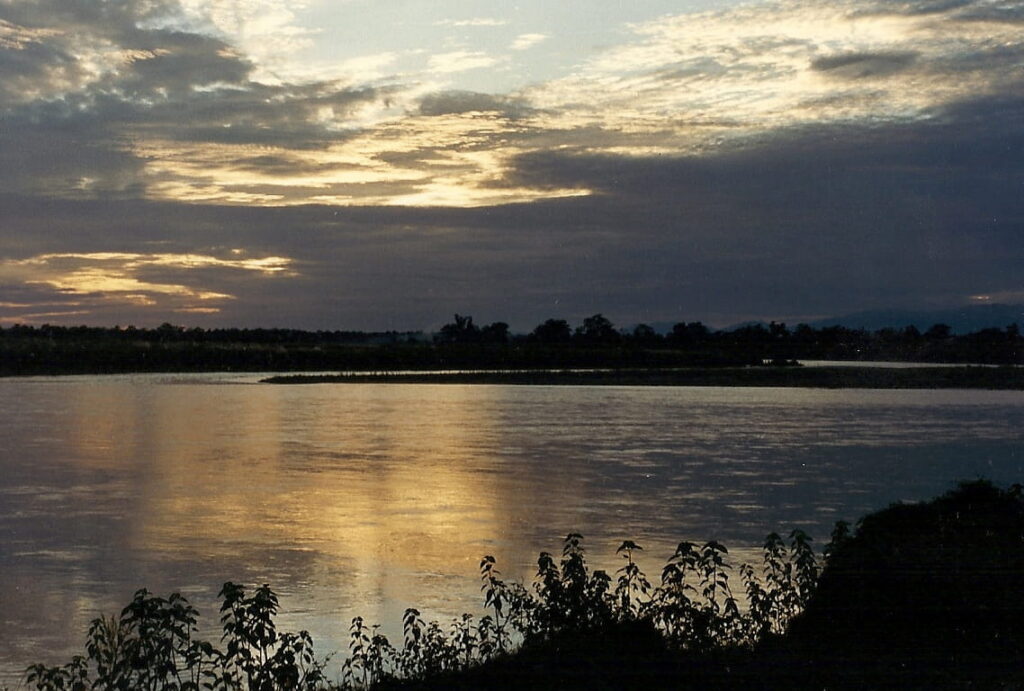
Rapti River, Chitwan National Park, NEPAL
Looks idyllic doesn’t it, gentle flowing river with a peaceful sunset. Well don’t be fooled, there are wild beasts here. This region, west from Kathmandu but near the Indian border is a true jungle where you may encounter wild tigers, elephants, rhino, cobra or crocodiles. Of course there are plenty of other deadly animals but these are the star attractions. When Steve suggested to me that we should visit ‘the jungle’ I must admit to being a bit apprehensive. But before we go on that journey I want to share more of Kathmandu…
One day Steve and I went walking through a market area and we came across a vender that was selling Thangka paintings. Well, being an artist I couldn’t just walk by now could I. Upon scrutiny I was amazed at the delicate blending of colour and the absolute control of very fine lines in the artworks. Although I am an artist, I also know my limitations. I was blown away by how precise the line work was. After talking to the artist I discovered that he does Thangka classes so I enrolled in his painting class. The class would occupy my time for a solid week – 9am to 5pm (I was on holidays but somehow back at work lol).
There were 3 ‘westerners’ taking the class and our first lesson was how to grind pigments from natural ingredients to make the paint. Then we got a crash course about the spiritual and religious meaning behind the Thangka. Next, how to sit cross legged for hours on end without getting incredibly uncomfortable – not true, it was tortuous. Yet there is something even more unbearable than the sitting – listening to a handful of Bob Marley songs on a continuous loop for 8 hours a day, seven days in a row. I used to love Bob Marley. ☹
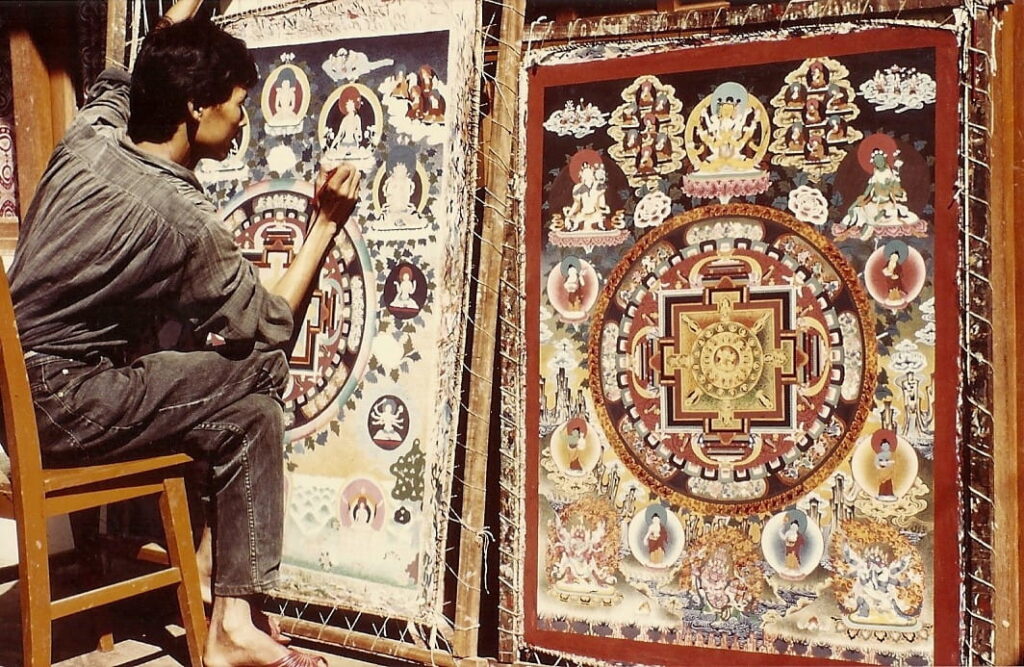
Robi demonstrating how to paint a Thangka
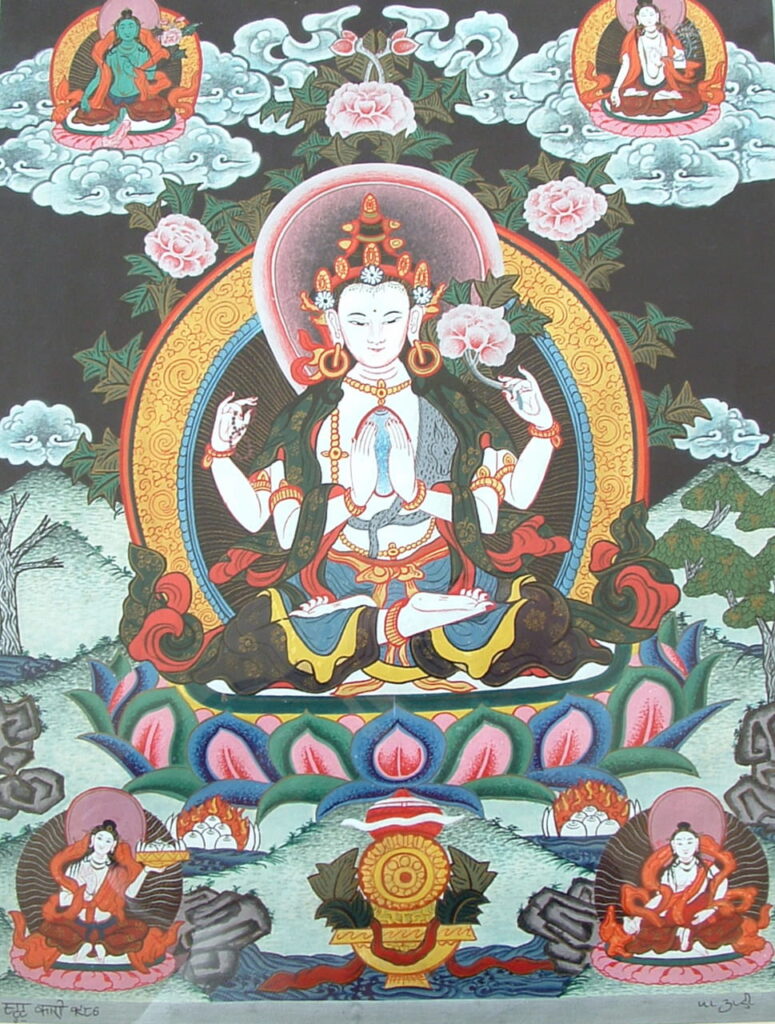
My Thangka painting – now proudly owned by my brother Stephen. In case you are thinking… I signed my name in Nepalese to make the Thangka look authentic! Robi helped with the faces and the hands.
back to the jungle
So travelling the 160klms from Kathmandu to Chitwan National Park on a bus was a very gruelling trip with plenty of unexpected excitement (potholes or landslides), but on a bad day, can take up to 8 hours. As we passed Sauraha, a small town nestled on the banks of the Rapti River my excitement rose – because Sauraha is the gateway to Chitwan National Park. After such an arduous experience, I was very happy to finally disembark from the overcrowded bus!
We stayed at Wendy’s Lodge. The accommodation was individual mud huts and whilst these structures and the internal furnishings are very basic, I found my hut to be cosy and comforting. After being packed like sardines on the bus, it felt good to be able to move around, stretch a bit. We settled into our new digs but after dark there’s nothing to do here (no electricity) so an early night was the agenda. As my head hit the pillow I had a random thought “what if a tiger comes through my window whilst I am asleep” ? This crazy notion remained in my head, thus, sleep was unsettled.
In the morning I awoke in terror. There were loud chaotic breaking noises right outside my hut and I couldn’t quite grasp what was happening. It sounded like something very large attacking my hut, maybe trying to knock it down? Heart pounding, expecting the worst I jumped out of bed before venturing to peer through the window. Relief washed over me. There was a boy straddling an elephant and a banana tree lay demolished beside the elephant. All that panic and fear over a friendly elephant wanting breakfast!
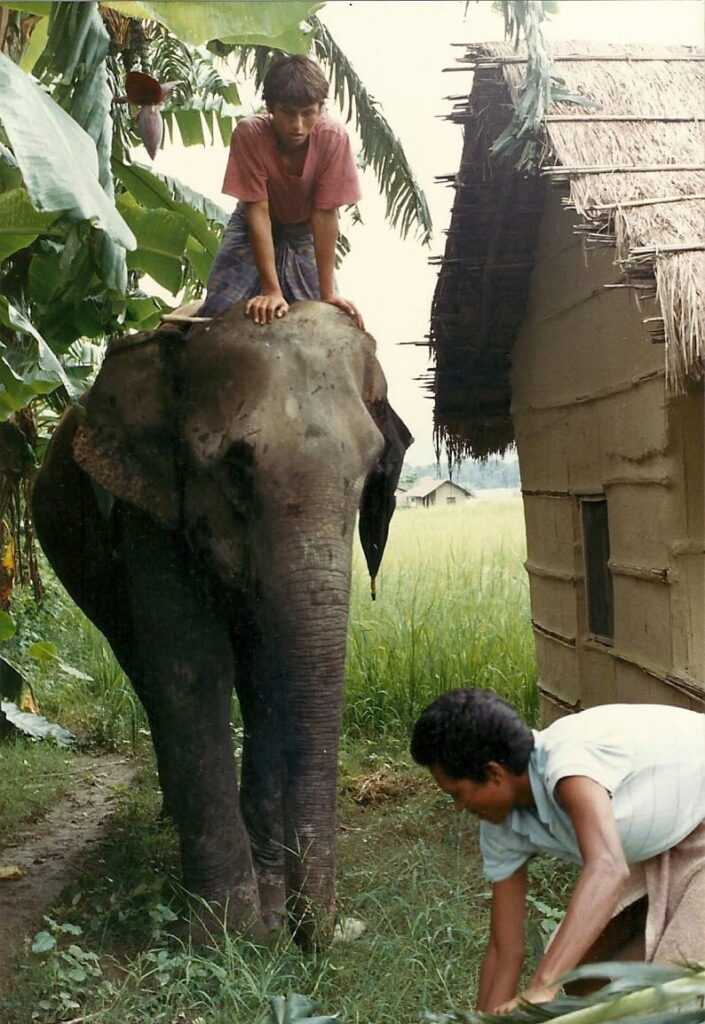
Marauding elephant behind my hut
safari time
After the unique and noisy wake up call (elephant alarm) we consumed breakfast, cornbread and dahl… again. Don’t get me wrong, it’s a nice combo but after my ‘incident’ with meat (Brother Knows Best – part 2 – Kathmandu story) – it’s all we ever ate, 3 times per day!
After brekkie we do a bit of walking around the lodge, take a few photos, partake in chatting to the staff while waiting for our elephant ride. I asked “do you ever have wild animals here at the lodge” and a staff member replied “of course. Sometimes the elephants come and destroy our crops. We have had rhino here as well, they are unpredictable and dangerous so we just stay inside until they go away”. I asked another question “what about going into the jungle without a guide, are we allowed to do that”? He replied “once a German man went into the jungle and tried to feed the rhino but the rhino charged him. His arm was so badly damaged he had to have it amputated”. That bit of information baffled me. Part of me thought “poor guy” whilst on the other hand “how stupid could he be, trying to feed a wild rhino”?
Time for our debriefing about behaviour whilst in the elephant cage, then finally we are ready to go. We headed out on our jungle expedition with confidence. Our vantage point the lofty height of an elephant carriage with our main goal, to see a rhino. Three elephants loaded with tourists headed out into the jungle, however with no sightings for the first hour, my excitement started to wane. Knowing our safari was coming to the home stretch on the time slot, I began to feel a pang of disappointment, maybe we wouldn’t see a rhino after all.
At this point we came into a large open grass area and there they were, a mother rhino with her calf wading in a small stream. As we came in closer, the mother goes into protective mode and charged at our elephant. Adrenaline pulsed through my veins as I lifted my legs up to avoid direct contact. Because I was riding on the smallest elephant, the rhino charged at us but the elephant handler swerved at the last minute to deflect the charge. My heart was racing and my camera was clicking – memorable stuff.
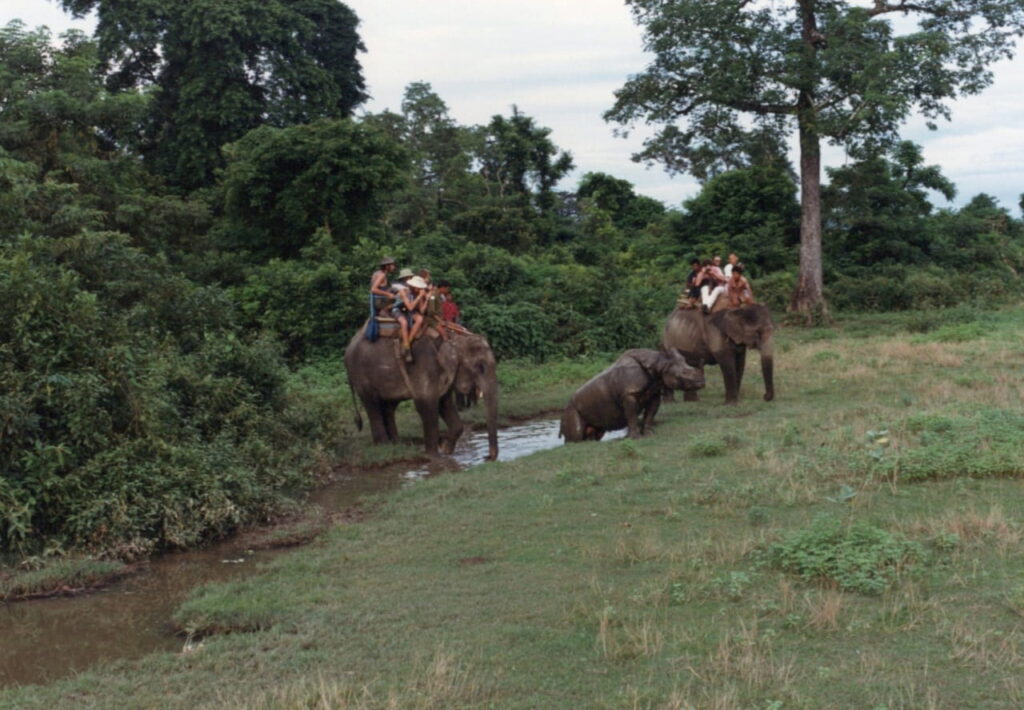
Elephant safari in search of wild rhinos
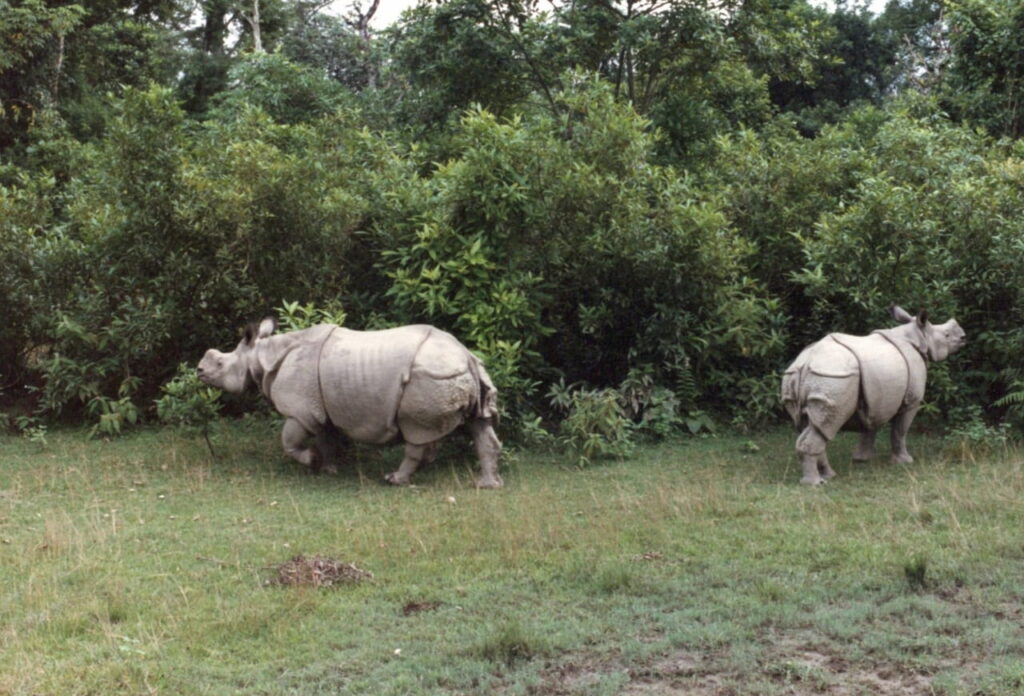
rampaging mother rhino about to turn then charge our elephant, to protect her calf
bionic bugs
The buzz was electric all the way back to camp with everyone babbling about our shared experience. We climbed down from the elephant carriages and thanked the mahouts for the amazing safari. After some time we all parted ways then Steve and I headed back to our huts to get ready for dinner.
Dinner at Wendy’s was memorable as well and I am not talking about the food. The ‘restaurant’ was an open air affair – it had no walls, apart from the ones enclosing the kitchen. The floor was just bare earth, with rudimentary tables and chairs under a protective roof. It got interesting after dark. As the light waned, candle lanterns were brought out by the staff.
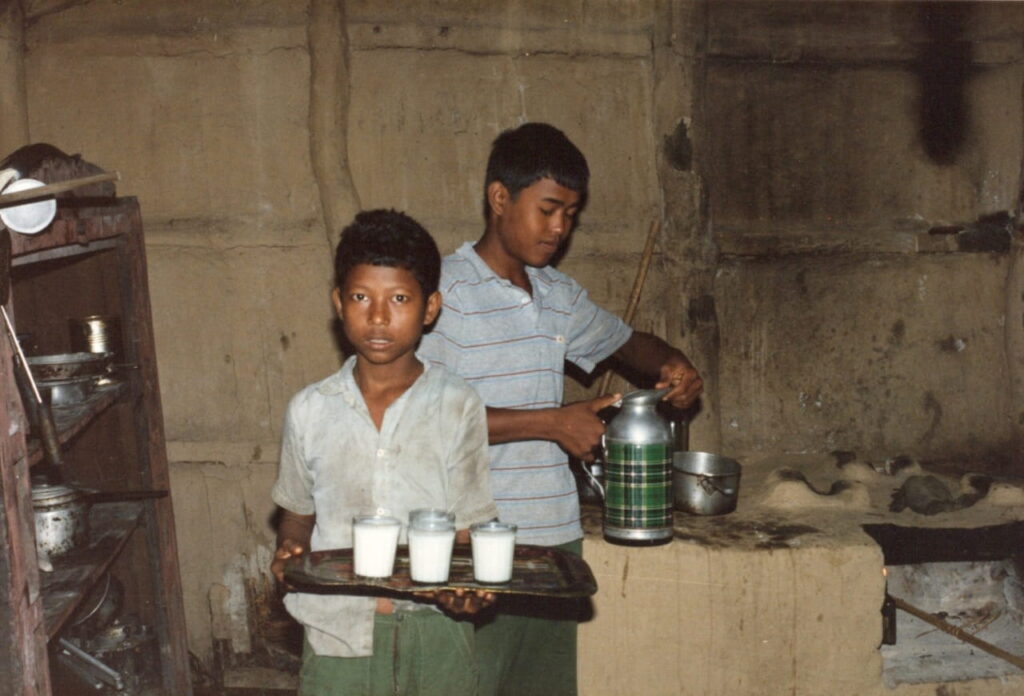
Powdered milk drinks get served as we order dinner.
We ordered from a limited menu and our chai (tea) was brought out first. As we waited for our food and with the darkness deepening we heard the onslaught approach.
It started faint but a loud and steady drone similar to a helicopter started to fill the atmosphere. Suddenly a large flying object smacked me in the face with a sting. “What the fuck was that” I shrieked! The insects out there were on steroids and they came in a swarm. You can hear them crashing into tables and chairs, then watch them spinning out of control after such a collision. Next thing we knew a behemoth smashed straight into our lantern and actually extinguished the flame, rendering us into darkness. Moments passed before staff with apologetic demeanour brought a replacement lantern. Wow, exciting stuff!!!
Day 2 and what to do? We already paid for an elephant safari and it was not cheap so we decided to entertain ourselves. More photos around our ‘little village’. What next? We came across a man painting a new sign for the restaurant so I enlisted an English speaking interpreter to tell the man “hello, my name is Stuart. I come from Australia and I am a sign writer “. The man smiled and gestured to me to do some sign writing. I looked at his brushes and felt pity. In Australia I have a large kit of professional sign writing brushes, a size 18 brush costs in excess of $100 alone. This man had a set of cheap hobby brushes that really are incapable of forming perfect letter shapes. However, I took up the offer anyway.
I started signwriting the word RESTAURANT and I really struggled with the poor quality brush. To make matters worse, the red paint lacked pigment, therefore it was terribly transparent so it would need 3 coats to render solid. As I finished my line of lettering a thought popped into my head, “I wish I had brought some sign brushes from home, I could have given them to him as a gift”. It was a humbling experience and I thanked the man for trusting me to paint on his sign.
boredom is dangerous
Day 3 and nothing to do. Boredom set in around mid morning and by midday. Steve suggested “do you want to go look for those rhinos we saw the other day”? “How, do you mean hire a ranger”? I asked. “Nah, cost too much. We’ll just walk in… on the way we can find some large sticks for protection” he replied. I reminded Steve about the German tourist that had his arm amputated but Steve shrugged it off with “we won’t get too close, just go looking and keep our distance if we see one”.
Well hello excitement – you are back!
the village we walked through on our way to find wild rhino
We set off around 1pm in stifling heat and hugged the river bank. After going through the local village we crossed some open fields filled with rice crops. We entered the jungle outskirts but it wasn’t like the jungle I had seen on TV. This is not Tarzan territory, this is South Asian jungle. Himalayan subtropical broadleaf forests cover 70% of the national park with the predominant species being Sal trees. The vegetation is thick, impenetrable in places. Savanna and grasslands cover 20% of the park with over 50 species of grasses including the elephant grass saccharum ravennae – one of the tallest in the world.
We quietly and cautiously walked into the jungle with our large sticks (weapons) raised. Because we were so close to the village there were paths to follow but with the passing of time, the paths became more overgrown or even obsolete. Without a watch it was hard to know how long we had been walking but one thing was clear, I remember my nerves were frayed. “This is crazy” I was silently thinking, there could potentially be a tiger stalking us right now. I couldn’t take it anymore. “Hey Steve, this is too dangerous, I think we should go back”! Steve pacified me with “yeah I agree. Let’s just go 10 more minutes and if we don’t see anything we will go back”.
We advance deeper into the jungle.
The path turned a corner and led back to a wide creek and I could not believe my eyes. Right in front of us, about 100 metres away – a rhino. I quickly fumbled for my camera and managed to get a single shot before the rhino disappeared into the dense bush on the opposite side of the creek.
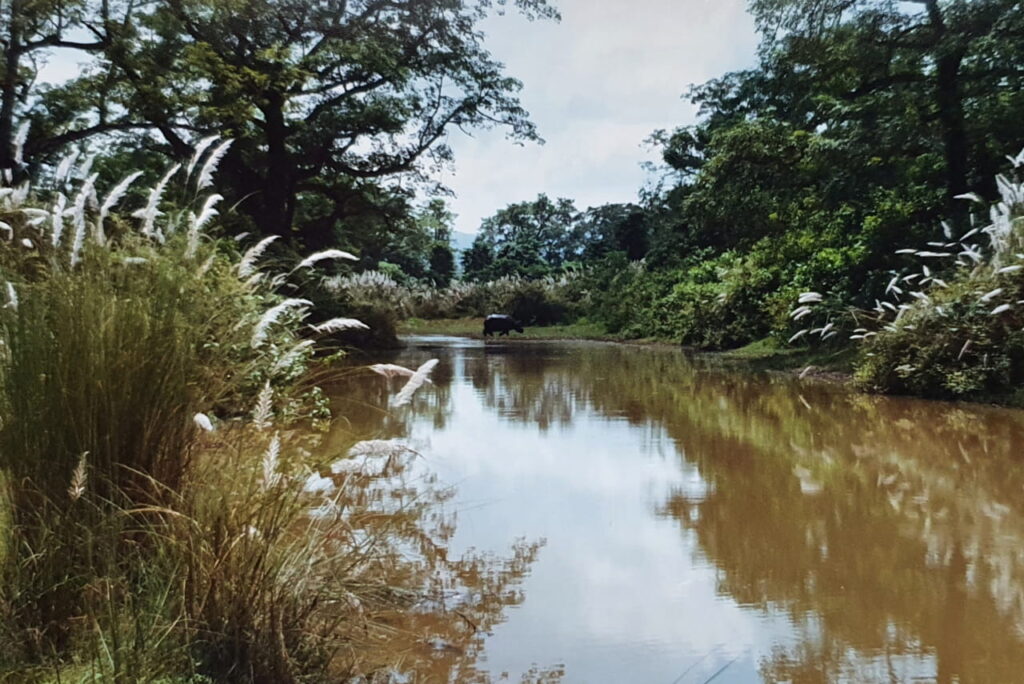
we finally spot a wild rhino on our foolish jungle adventure
We decided to investigate just one more time to see if we could get a closer snapshot. As we pressed on I started to rethink our decision. The undergrowth was getting more difficult now with long grasses making visibility diminished. I scanned the jungle nervously, looking for large trees that were easily accessible in case of emergency but there were none. Relatively small trees were abundant but not adequate for escape so a feeling of dread washed over me. Imaginary tigers invaded my mind again and the slightest noise had me swinging towards it with my stick raised.
Suddenly we heard movement to our right, something large was crashing through the undergrowth. I felt frantic as I looked desperately for our ‘best option’. Steve and I ran to a small stand of trees for cover, knowing a tiger could get us easily but we might be able to hide from a rhino. The noises intensified, along with our fear, before I saw an animal come through the jungle about 10 metres away. The wild beast about to attack us was…………………………………………….
A cow!
“What is a cow doing out here”? And now other one, ….. and another, followed by two village girls.
Well now it was just embarrassing.
The two village girls were just as shocked to see us as we were them. As it turned out, they came into the jungle to round up their herd of cows and get some vegetables for dinner.
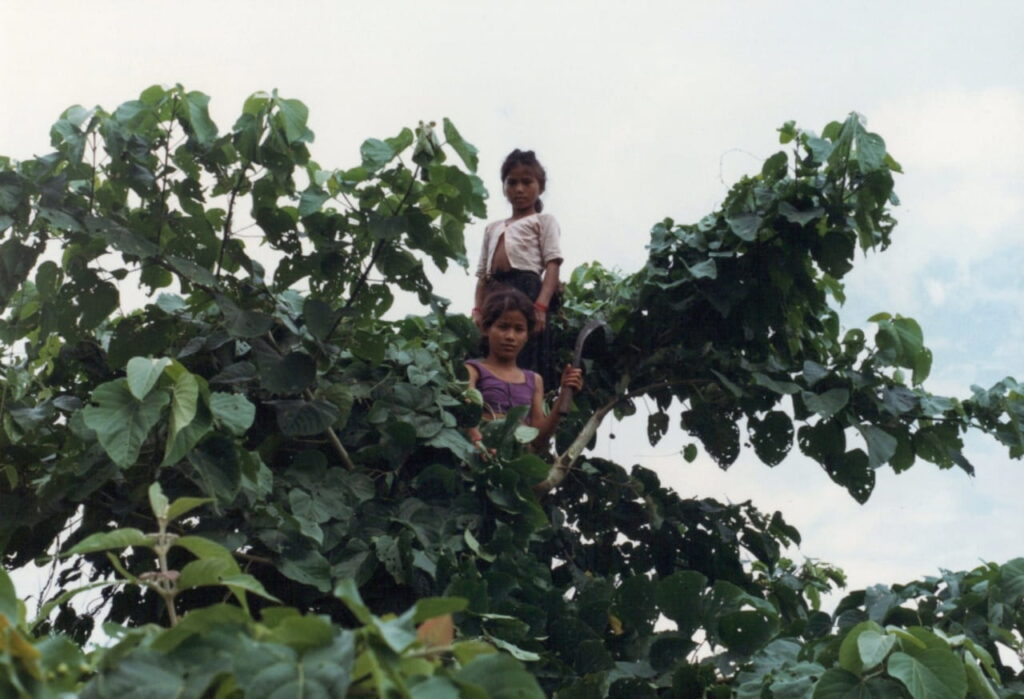
the girls we encounter in the jungle strip the tree of foliage in record time for dinner
So, we didn’t see a tiger – thankfully. In all probability the chance of encountering a tiger in the wild is quite small because they cover huge territories. The risk was real however, potentially there was a chance of being in the wrong place at the wrong time. Looking back on our adventure, you could label us Dumb and Dumber!